
Enter Valid Zip.

Legionella grows in warm, standing water — a system-wide risk shaped by a building's piping, circulation, and setpoints, not the water heater alone. Because Noritz commercial tankless heaters store very little water and keep it moving, they reduce the conditions for Legionella growth inside the heater. On its own, tankless does not prevent Legionella; it's the foundation of an engineered Noritz system designed to help control it.
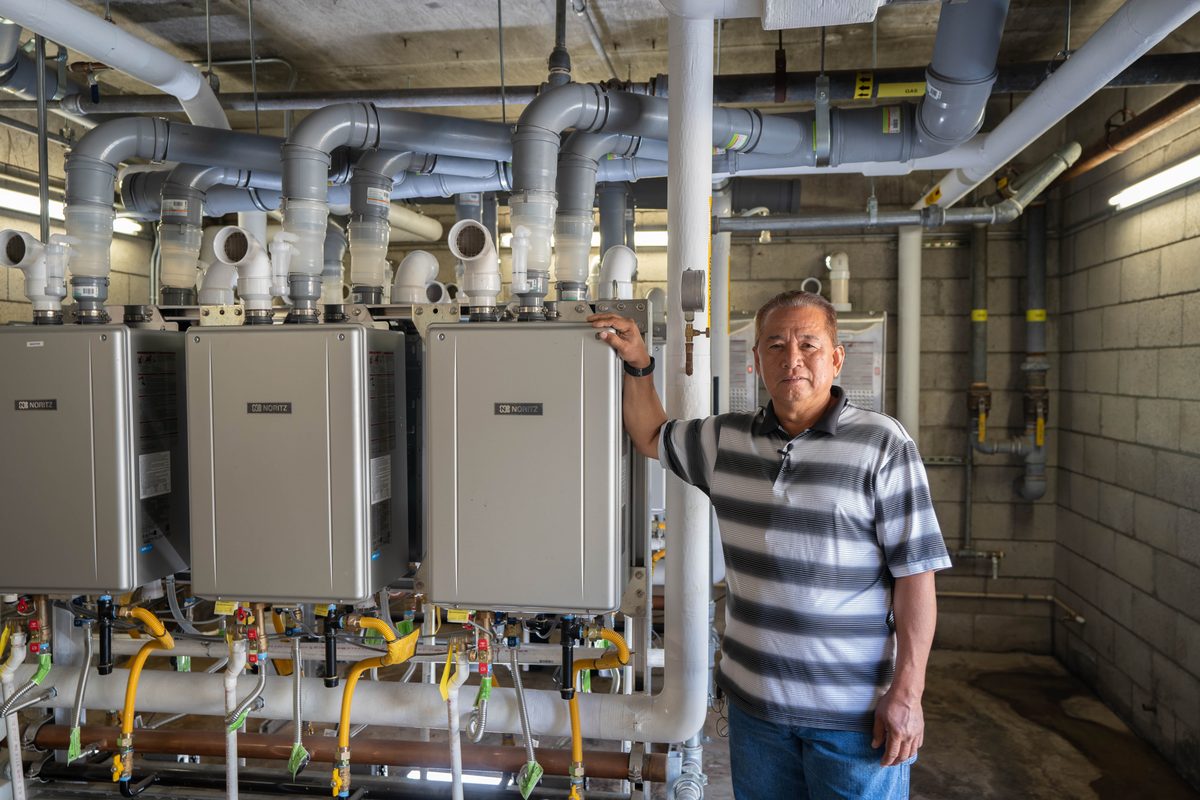
Legionella bacteria multiply fastest in warm, still water. A conventional storage water heater creates exactly that environment — and holds it, gallon after gallon, around the clock.
Illustrative temperature zones. Growth range and disinfection thresholds reflect widely cited public-health guidance; confirm against local code and your water management plan.
Legionella proliferates roughly between 77°F and 113°F. Tanks held at moderate setpoints — or with cooler bottom layers — park water right in that range.
Dozens or hundreds of gallons sit idle between draws. Low-demand periods — nights, weekends, seasonal buildings — let bacteria and biofilm establish.
Sediment and scale on tank walls form biofilm that protects Legionella from disinfection and reseeds the system after treatment.
Minimal stored water and constant flow reduce Legionella-friendly conditions inside the unit. A building's piping, circulation, and setpoints still determine system-wide risk — so tankless lowers in-unit risk but does not, on its own, prevent Legionella.
Only a fraction of a gallon is held inside the unit, so there's very little standing volume to stagnate between draws.
Every draw pulls fresh supply water and heats it in real time, so the system isn't recirculating a standing batch.
Units can run elevated delivery temperatures — one input to a Legionella control strategy when integrated with a control system and mixing valves for safe fixture output.
Multi-unit racks scale capacity without oversized storage, and let you service one unit while the rest keep the building supplied.
Schematic of the flow-through heating path. Simplified for illustration — not a plumbing or gas-fitting diagram.
When a fixture opens, cold supply water flows through a high-efficiency heat exchanger and is brought to setpoint in seconds. When the draw stops, so does the heating. There is no batch of warm water waiting in a tank between uses.
The result is far less standing water inside the heater. Building piping, recirculation loops, and setpoints still carry risk — so tankless is the starting point for a system engineered to manage Legionella, not a standalone fix.
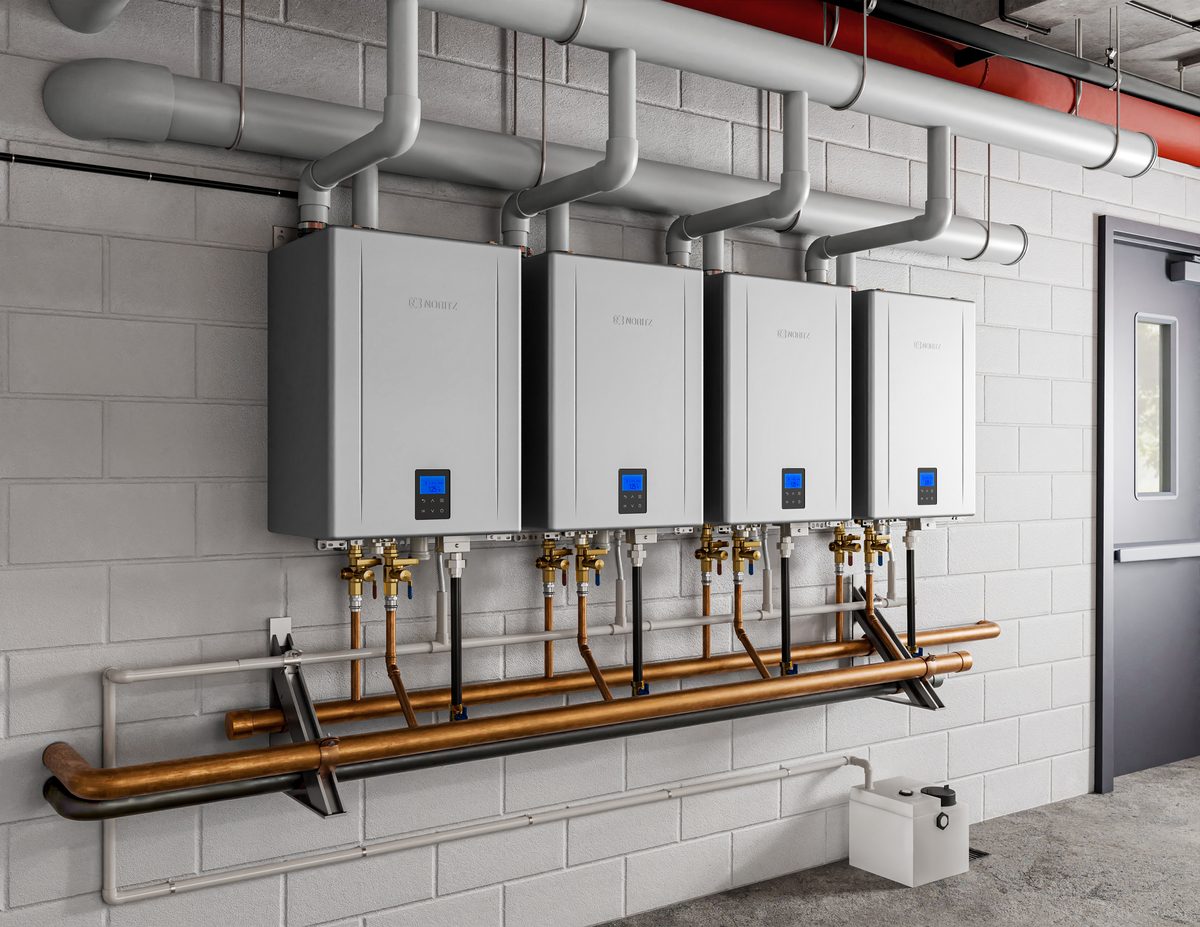
Reducing stored water is only the start. Because Legionella risk lives across the building — piping, recirculation, and setpoints — Noritz designs complete engineered solutions, including TWST rack configurations and TTS FIOP packages, built to help control and sanitize against it:
TWST rack designs set tankless delivery 15–20°F above the building setpoint to keep water out of the Legionella growth range.
TTS FIOP solutions integrate Legionella control and sanitization into a complete, factory-engineered package.
Every application is engineered to design drawings — Noritz does not recommend field-engineered installations without them.
Tankless on its own does not prevent or eliminate Legionella. Reducing stored water inside the unit is one factor within a building water management program under ASHRAE 188; effective control depends on total system design, operation, and maintenance.
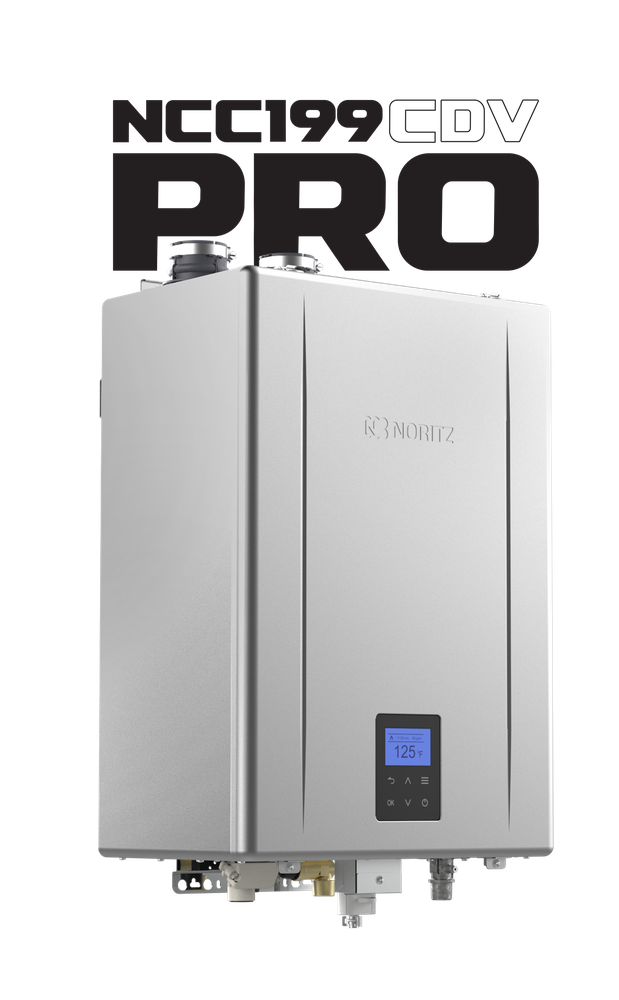
The NCC199CDV is Noritz's flagship commercial condensing tankless unit. A single unit delivers high-efficiency, on-demand hot water — and multiple units link into a rack-mounted multi-system that scales to the largest commercial loads without reintroducing bulk storage.
| Specification | Value |
|---|---|
| Model | NCC199CDV |
| Type | Indoor/outdoor commercial condensing tankless, direct vent |
| Max Gas Input | 199,900 BTU/h |
| Min Gas Input | 12,800 BTU/h (modulating) |
| Max Flow Rate | 11.1 GPM |
| Energy Factor | 0.98 UEF |
| Fuel | Natural Gas or Liquid Propane |
| Venting | 2″, 3″ or 4″ PVC / CPVC (Sch 40/80) or PP; direct-vent, single-vent convertible, or outdoor |
| Multi-System | Up to 24 units with a system controller (up to 8 via Quick Connect Pro) |
Additional specifications: 26.1″ H × 18.1″ W × 11.8″ D, 62 lb · 0.71 gal water-holding capacity · temperature range 100–185°F · 16:1 turndown ratio · 10-year heat-exchanger, 5-year parts, and 1-year labor commercial warranty. Source: Noritz NCC199CDV specification sheet (Rev. 12/2025).
No. Tankless on its own does not prevent or eliminate Legionella. Because our heaters store very little water and keep it moving, they lower the risk of growth inside the heater — but a building's piping, circulation, and setpoints still create risk. Eliminating Legionella requires elevated setpoints integrated with a dedicated Legionella control system, delivered through an engineered Noritz system solution.
Legionella grows most readily between roughly 77°F and 113°F (25–45°C). Inactivation begins above about 120°F and reaches rapid, reliable kill only at 140°F (60°C) and above. A low delivery setpoint — say 120°F — combined with a poorly controlled recirculation loop can leave water in the growth range for hours, which is why engineered designs raise setpoints and control circulation.
ASHRAE Standard 188 calls for identifying and controlling conditions that allow waterborne pathogens to grow. Tankless supports that goal by reducing standing water and enabling consistent temperature control. It is one engineered element within the broader plan, which also covers distribution, monitoring, and remediation procedures.
Yes. Multiple units are combined into manifold systems that scale to the peak simultaneous demand of hotels, multifamily, healthcare, and institutional buildings — without the oversized storage a tank system would require. Redundancy also lets you service one unit while the rest maintain supply.
Talk with a Noritz commercial specialist about an engineered system — including TWST rack configurations and TTS FIOP solutions designed to help control and sanitize against Legionella.
Legionella management depends on total building system design, operation, and maintenance. Noritz tankless water heaters reduce stored water within the unit but do not, by themselves, prevent, control, or eliminate Legionella. Effective control requires appropriate setpoints integrated with a dedicated Legionella control system and an engineered system design. This information is general and is not a substitute for professional engineering, code, or regulatory guidance.