
Enter Valid Zip.


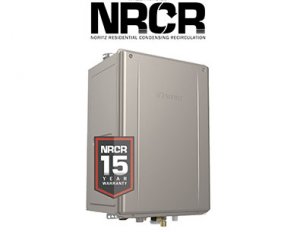
The New Noritz Outdoor Conversion Kit For NRCP Tankless Water Heaters Has Arrived
You can now install your NRCP tankless water heater outside! In an effort to lower installation time and costs and boost flexibility for contractors and consumers. Introducing the New Noritz Outdoor Conversion Kit for the NRCP condensing unit.

The VCK-NRCP kit comes with (1) an outdoor vent cap assembly with decorative plate and packing, (2) an exhaust pipe with an adaptor and bracket, (3) a bird screen to protect the exhaust aperture, and (4) an outdoor front cover with cap and sealing, an extension cable, screws and an instruction manual.
For consumers living in warmer parts of the country, such as the south and west, the outdoor kit provides greater installation flexibility (The water heater is designed to automatically prevent freezing to temperatures of 5F°/-15°C). If they want to save space inside their homes, they can now locate the NRCP unit outside. The provided extension cable still allows the unit’s control panel to be installed inside the home for continued convenience.
Furthermore, the outdoor vent cap and cover will ensure that the elements do not damage the unit. In fact, placed outdoors, the unit has been tested to withstand 20-30 inches of water per hour—literally buckets-full.
For contractors, the outdoor conversion kit allows for reduced installation time and costs. Indoor units require venting to be run from the inside to the outside, which in turn involves additional materials and added labor. The outdoor conversion kit eliminates this extra time and cost because it allows the NRCP unit to vent directly into the open air. The aforementioned protective screen keeps birds and other small animals out.
The outdoor conversion kit adds yet another benefit to an already well-equipped water heater. A circulating pump inside the unit keeps hot water close to the outlet — such as a shower head — minimizing the wait and, therefore, the waste of unused potable water down the drain. Saving water, in this case, is extremely beneficial because recirculation also avoids wasting the energy used to heat that water. Learn more about hot water recirculation.
For more information on the NRCP unit, please visit https://www.noritz.com/blog/understanding-benefits-nrcp-line-tankless-water-heaters/
The NRCP outdoor conversion kit becomes available this month (December 2016) from Noritz. Remember also that by switching to a tankless water heater, you can qualify for sizeable federal and/or state energy rebates. Find more information about energy rebates on Noritz tankless water heaters.
Benjamin Franklin Plumbing Promotes Noritz Water Heaters
Benjamin Franklin Plumbing is a full-service provider of residential plumbing with locations spread across the United States. In particular, its Chandler, AZ, franchise stands out for its focus on providing customers the energy and performance benefits of tankless water heaters.
Michael Smith has been Operations Manager of the Chandler location for the past 11 years, overseeing a staff of 10 technicians, two installers and two apprentices. Upon arrival in 2005, Smith spearheaded the company’s acceptance and promotion of tankless water heating technology.

“I wanted to be an innovator for our company and offer customers the continuous hot water and energy savings of tankless water heaters,” says Smith. To accomplish this, he placed a heavy emphasis on training his employees in tankless and taking advantage of any technical representatives visiting the area—especially those from Noritz.
“To me, Noritz tankless water heaters became the best thing since sliced bread for their simplicity, style and design,” explains Smith. “We take great pride in explaining to our customers, who are often not familiar with tankless or are turned off by the higher upfront costs, that it saves energy and will pay for itself down the road. Customers are also drawn to the space savings gained by not needing a large tank, and they also like the interchangeable parts and ease-of-control.”
Today, Noritz is the only brand of tankless water heater that Smith’s company installs. “One competitor actually offered to give each of our technicians a free tankless water heater if we switched from Noritz to them,” recalls Smith. “We graciously declined.”
Over the past several years, Smith has seen growing tankless sales, as customers recognize the technology’s many benefits. Currently, Smith estimates that one-third of his monthly sales are tankless water heaters. “Also attractive to customers are the long warranties and the fact that we provide annual maintenance work,” he says.
One particular model that Smith praises is the EZTR40 condensing tankless water heater. “It’s phenomenally easy to install with its top-of-unit, hot- and cold-water connections and its ability to use the same venting and gas line as the old tank type it replaces,” he says. “A single installer can typically install an EZTR40 in only three to five hours.”
Case Study: Mesa Arizona
Recently, Benjamin Franklin Plumbing demonstrated the value of tankless water heaters in a Mesa, AZ, residential application. A homeowner had two aged, 75-gallon tank-style water heaters servicing a roughly 7,500-square-foot house with seven bathrooms. When one water heater burst, the owner called Mark Felice, Field Supervisor at Benjamin Franklin Plumbing in Chandler, who recommended replacing both with Noritz NRCP1112-DV-NG tankless water heaters for their built-in recirculating pumps and stainless steel heat exchangers.
The units’ installation lasted six hours with three installers, and there were no complications. By choosing tankless, the homeowner is saving an estimated $700 per year in energy costs and no longer needs to worry about bursting storage tanks full of hot water.
It’s just one example, out of the roughly 120 installs per year, of how tankless water heaters are helping Benjamin Franklin Plumbing in Chandler provide exceptional service and long-term value to its customers.
For more information on the Chandler, AZ branch of Benjamin Franklin Plumbing, please visit https://www.benfranklinplumbingaz.com/
Benefits of Installing a Noritz Combination Boiler, Part 2: Outdoor Temperature Reset
The new CB Combination boiler/tankless water heater (CB Combi) from Noritz has a number of installer and homeowner advantages — over not only traditional, stand-alone boilers and tank-type water heaters, but also other combination units on the market.
Previously in this series, we explained how the Combi’s unique flow control valve helps achieve desired water temperature for the user. In this post, we will discuss a Combi component that contributes to its energy-efficient operation and qualifies it for numerous rebates: the outdoor temperature reset control.

In any residential hydronic heating application, the heat load, or how much heat must be supplied to keep the home at the desired temperature, depends on the outdoor temperature. The larger the temperature difference between the outside and inside, the faster that heat will dissipate into the environment (depending on the home’s insulation).
“Oftentimes, when the outdoor temperature is really cold, the homeowner will know to raise the setpoint temperature inside,” says Randy Oshiro, Assistant Manager of Engineering at Noritz America. “However, when the outdoor temperature is really warm, homeowners often don’t know to lower the setpoint, which results in energy inefficiencies each time the boiler turns on and off.”
Short cycling occurs when a boiler fires on and off repeatedly, merely to raise the temperature of the water in its heating system, regardless of whether the home needs heat. This can happen when the boiler setpoint temperature is set unnecessarily high relative to the outdoor temperature. Since a boiler operates most inefficiently during its combustion and purging (turning off) stages, frequent cycles waste energy. To avoid this, the user needs either to remember to lower the indoor temperature manually; or to install an outdoor temperature reset.
Automatic Adjustment
An outdoor temperature reset control, such as the one that comes with the Noritz Combi, monitors the outdoor temperature and relays that information directly to the boiler, which adjusts the setpoint accordingly. So, if the outdoor temperature is warm, the hydronic system setpoint temperature will be reduced; if it’s cold, it will be raised.
This automatic adjustment keeps the boiler running for as long as possible, minimizing wasted energy during the start-up and shut-off phases and leading to energy savings.
The proper location of the sensor is critical. Place it on the northeast side of the home if possible, but certainly make sure it stays out of direct sunlight, which can mess with its temperature readings.
Several state energy rebates recognize the added energy efficiencies garnered by this technology and can be awarded to users who purchase units like the Combi, offsetting its initial cost. For example, Massachusetts offers a $1,600 rebate to homeowners who install an integrated condensing boiler and water heater.
Noritz’s outdoor temperature reset control is fairly unique in that it comes standard with each Combi unit. Many other manufacturers do not offer this, requiring the sensor to be purchased separately.
To learn more about the CB Combi, please visit https://www.noritz.com/combi/
Noritz Tech Support To The Rescue
One of life’s most frustrating experiences is being put on hold for an indeterminate amount of time when calling any company’s customer service number, be it for a malfunctioning cable box, “blue screen of death” on your computer or a malfunctioning water heater. For this reason, Noritz has updated its technical support system to serve customers in a faster, more efficient and more predictable manner.
Here are some of our new technical support features:
Streamlined Menu: Nothing is more irritating than calling a company and not knowing which extension or department to reach. For this reason, we  have condensed our greeting to allow customers to get to the appropriate department quickly and easily. The top three cues are at the top of the menu: Press 1 for Tech Support and Warranty Claims; Press 2 for Sizing; Press 3 for Sales and Parts Ordering.
Useful Announcements: It’s true—we have only a limited number of technical support agents, and sometimes we have to put our customers on hold. But, unlike those places that play 1980s elevator music while you wait, we try to offer some value. You will hear our support website address where you can go find technical documentation, warranty status, troubleshooting and frequently asked questions.
During this waiting time, you can also double-check that you have everything you need for us to help you as efficiently and effectively as possible. Here’s a brief checklist:
Your name and/or company name.
Your reference ID number (if you're calling back).
The model number and serial number of the product that you are servicing.
In addition, you will need to be in front of the product with a Phillips screw driver, manometer and multimeter.
Estimated Wait Times: One of the worst aspects of getting put on hold is the wait-time uncertainty. If you know it will be a long wait, you might hang up and call back. But if you don’t, you will likely stay on the line hoping that, any second, someone will answer. Oftentimes, this leads to long waits and wasted time. Fortunately, Noritz now offers estimated wait times, which update every minute. That way you at least know where you stand. Furthermore, Noritz does callbacks if you find you are unable to stay on the line. So there’s no pressure to wait at all.
While these improvements are meant to help callers waiting on hold, our first priority is, and always will be, to answer every call as quickly as possible while giving our customers the best service. We are continually working on training our teams so that we can provide superior support for a superior product.
Contact Noritz at 1-866-766-7489.
Go For Noritz Winners Showcase Top-of-the-line Installs
Noritz’s recent #GoForNoritz contest gave our social media followers the opportunity to win gift cards worth up to $500 by sharing photos of their best Noritz tankless water heater installations on our Facebook and Instagram pages.
Well, the verdict is in and here are our top three winners!
FIRST PLACE: John Thompson, owner at Thompson Family Plumbing & Rooter Inc.
Congratulations to our first place winner, John Thompson, owner of Thompson Family Plumbing & Rooter Inc. in southern California! The winning photo featured an EZTR40 residential tankless water heater installation.

A plumber for nine years, Thompson has been installing Noritz throughout his career. He is particularly drawn to the energy-saving benefits of tankless water heaters, the ability to swap out individual parts instead of the entire unit if something is wrong, and the built-in recirculation pump found in the NRCP model.
“After installing an NRCP unit in my own home, I’ve been saving $100 in energy every month,” says Thompson. “Noritz’s energy-saving benefits help my company achieve its dual mission of pleasing customers and protecting the environment by reducing our carbon footprint.”
First Place Install

SECOND PLACE: Eric Stromerson, Van’s Plumbing & Electric, Inc.First Place Install
Congratulations to our second place winner, Eric Stromerson, Lead HVAC Technician at Van’s Plumbing & Electric in Bellingham, WA. His submitted photo featured a residential NRCP-1112 tankless water heater.

Stromerson has been in the HVAC business the past 20 years and is a huge proponent of tankless water heating technology for its energy savings and ability to provide continuous hot water. He explains that Noritz heaters, with their ease-of-installation and helpful tech support, are the preferred option for his customers.
“We encourage our customers to install tankless over tank-type water heaters, specifically the Noritz brand,” says Stromerson. “We frequently put in NRCP-1111DV units, and I find they are much simpler to install than other systems.”
Second Place Install

THIRD PLACE: Scott King and Moises Ortiz, Alpha Plumbing & Heating Services, Inc.
Congratulations to our third place winners, Scott King and Moises Ortiz, owners of Alpha Plumbing & Heating Services, Inc. in Westchester, NY. They entered a photo of a Noritz-donated CB Combination Boiler, which was installed in a residential application.

King and Ortiz have been installing tankless water heaters for the past seven years, including Noritz models. Their primary reason for switching to tankless was the energy efficiency gained by heating water only on demand, instead of around the clock.
“I’m grateful to Noritz for donating the combination unit to this recent residential application,” says King. “It was a smooth installation, and I’m impressed with its efficient use of space and energy, as well as its overall performance.”
Third Place Install

Why Install a Noritz Combination Boiler 1: Variable Flow Control
The new CB Combination boiler/tankless water heater (CB Combi) from Noritz has a number of installer and homeowner advantages, not only over traditional, stand-alone boilers and tank-type water heaters, but also over other combination units on the market.
In this new blog series, we will explore some of these user-installer advantages. First on the list—the CB Combi’s unique flow control valve.
Why it’s there
To understand what the flow control valve does, you need to recognize the problem that it solves. If multiple fixtures are generating simultaneous demand for hot water, more energy may be required than the water heater can provide.
In such a scenario, the water emerging from the various fixtures would be colder than the desired setpoint temperature, because heat is not being transferred quickly enough due to the high volume.
What it does
The CB’s flow control valve acts to ensure that the domestic hot water (DHW) supply always emerges at the desired temperature by slowing down the water flow through the unit during periods of multiple fixture demand. Reducing the flow rate ensures enough time for the DHW to reach the setpoint temperature for all fixtures. 
Randy Oshiro, Lead Engineer at Noritz America, explains that one consequence of slowing down the flow rate could be slightly reduced water pressure from the fixtures. “The reduced pressure is so slight that it’s practically unnoticeable,” assures Oshiro. “The flow control valve sacrifices this tiny amount of water pressure to ensure the far more important and noticeable ability to meet desired hot water temperatures across multiple fixtures.”
Conversely, if there is a sharp change in hot-water demand, the flow control valve helps prevent scalding by adjusting the flow accordingly. “The goal of any domestic hot water heater is to deliver water at the desired temperature as quickly as possible,” explains Oshiro. “The flow control valve accomplishes this by either restricting or expanding water flow, depending on demand.”
Why it’s unique
Most other combination boilers on the market lack a flow control valve, meaning they either accept the fact of colder water in high-volume scenarios or require an add-on, flow-limiting device. Only the flow control valve inside the CB Combi by Noritz allows the user to enjoy desired water temperature for as long as needed, fulfilling the tankless promise.
To learn more about the CB Combi, please visit https://www.noritz.com/combi/
Using The EZTR40 To Replace Your Tank Water Heater.
If you’ve been in the plumbing and HVAC fields for a while, then you’ve replaced countless water heaters for customers. It has probably become a matter of course—a client’s 40-gallon, gas-fired, storage tank-type water heater fails, and you replace like for like.

Although you may have installed tankless water heaters now and then, they may not be the first option that comes to mind when replacing your customers’ tank unit—after all, they often require the extra cost and labor of installing new plumbing, venting and gas connections.
Recent innovations in product design and manufacturing, however, have made replacing tank with tankless smooth and far less costly. The residential EZTR40 condensing tankless water heater from Noritz embodies this innovation and makes the upfront costs of switching to tankless lower than ever.
Here’s how the EZTR40 completely eliminates the old challenges contractors faced when making the switch:
Venting:
A major objection contractors raise to switching from tank to tankless is the need to change out the venting to accommodate the new heater.
It’s true—the EZTR40 uses different venting—two-inch, flexible polypropylene tubing, to be exact. But all you need to do is run it through the existing B-vent, formerly used by the tank water heater being replaced. There is no need to go through the hassle of pulling out the old vent.
Gas Line:
Traditionally, one of the most expensive aspects of replacing tank with tankless was the need to upsize the gas line from half-inch to three-quarter inches. The reasoning was simple; the tankless unit needs enough fuel to superheat the water on demand.
Updates to the National Fuel and Gas Code now permit half-inch gas piping for inputs up to 174,000 BTUs per hour, as long as the gas pressure to the water heater is at the appropriate level. This means that the EZTR40 can connect to the same half-inch gas line as the tank unit it’s replacing, cutting labor time by up to half.
Water Connections:
Switching to a tankless water heater used to require extra plumbing because water connections were located on the bottom of the unit instead of the top. This led to extra material and higher labor costs, as well as a messy maze of pipes meandering around the unit.
The EZTR40’s connections are conveniently located on top of the unit, allowing a clean and simple switch utilizing the same flexible hot-and-cold-water lines as the tank-type water heater. This not only saves the contractor time, but gives the setup a much cleaner look for the homeowner.
Replacing tank with tankless was once difficult and expensive. Now, it’s essentially no different than replacing tank with tank, except the customer gets to reap all the energy- and space-saving benefits of a tankless water heater.
For more information about the EZTR40, please visit https://www.noritz.com/eztr/
Tankless water heaters are rising in popularity thanks primarily to their limited energy consumption. Besides savings, however, many consumers have switched to tankless water heaters for their space-saving design and variety. Those looking to heat water for a small house or an entire office complex can usually find a model and plan right for their project, regardless of whether they need a central water heater or demand heaters next to major appliances.

Not all tankless water heaters are suited for every situation, however, and here are five very important things to consider before going tankless.
Do you need Natural gas or Propane?
Although tank-less water heater are electrical unit they run off either natural gas or liquid propane. This source of gas at times can be an issue and the question must be asked.
Which is the best choice for you and your water heater? The choice is up to you.
Depending where you live. Some areas only offer natural gas which in most metropolitan areas is the norm. For those who live if the aerial areas propane is the only choice which when it comes to tank-less heater you still have the ability to use large residential propane tanks this can be an issue when choosing the correct heater for one’s application. Propane tanks would need to be filled every time one runs out of gas, which presents a dilemma if one is not aware how much their propane capacity is.
How Effective Are Tankless Water Heaters?
Traditional water heaters can boil water just as hot as any tankless water heaters but are less efficient and less timely in the way they heat the water. Tankless heaters are more effective in heating water by a factor of plus or minus 2 degrees in less time.
In addition, tankless heaters can heat multiple fixtures with ease. But depending on the ratio of water to fixtures you may have to purchase multiple units.
If you properly install your tankless heater with a Noritz professional, users can reduce the hassle of experiencing heat loss, temperature fluctuations, or calls to Noritz Support for troubleshooting.
What Can You Afford?
Tankless water heaters save money in the long run, but they do cost more up front than a traditional water heater. If you decide you need multiple tankless water heaters, you have the ability to connect multiple units such’s as a NRC98-DV through system controllers. This allow the units to communicate and work together to meet the heating demands when necessary.
Do You Re-Circulate Water?
While it isn’t impossible to attach a re-circulation system to a tankless water heater, it comes at a cost. Not only will your ‘tankless’ water heater likely need a side tank, but contractors will have to dedicate a lot of time to the project. One way to cut down these cost is by looking into tankless heaters such as the NRCP or the Combi line of heaters. Both lines come with built- in re-circulating pumps which cut down on additional hardware.
Are You Ready to Make a Change?
Once you’ve thoroughly examined your options, it’s important to make sure you’re ready for the change. A new system will always require an adjustment period for users. Change can be a good thing, though. After all, going tankless means lower energy bills, and that is something consumers are always ready to try.
As you consider, think about your situation, your demands, and the potential benefits of a tankless water heater. Are you ready to go tankless?
Combi Boiler Training
Noritz University has a new class. Part one of what will be a two-part course on the new CB Combination Boiler is now available for professional plumbing, hydronic heating and HVAC contractors to take online, free of charge.
The training prepares contractors to be on the forefront of a rapidly expanding segment of the residential boiler market, offering them a competitive advantage in meeting this growing demand.

The award-winning CB Combi is a year-round, whole-home solution that delivers hot water to both plumbing and hydronic heating applications. Its fuel-saving performance meets “Energy Star Most Efficient” standards, which represent the EPA’s highest efficiency rating and allow homeowners to qualify for various state energy rebates.
Part one of the course covers basic features, specs, system components, applications and venting options. Here’s a breakdown of the course contents:
PRODUCT SERIES:
RESOURCES
Trainees can register by signing up at www.training.noritz.com. Members of Noritz’s PROCard program can elevate their Noritz “Power Rankings” by successfully completing the course. This means their contact information will show up higher in the program’s search results and thus be more visible to prospective customers.
The course takes approximately 30 minutes to complete and includes a multiple-choice quiz at the end. A second part to the course, which will offer a more in-depth synopsis of system setup and troubleshooting, will be available by the end of August.
In addition to this latest course on the CB Combi, Noritz University offers three others: The Online Residential Level 1 Training; The CDR1 Training for the NRCP series of residential, condensing tankless water heaters; and the EZTR40 Training.
“The CB Combi is a revolutionary product that allows consumers to combine their comfort heating and domestic hot water into one space-saving solution,” explains Jason Fleming, Sr. Marketing and Customer Care Manager for Noritz. “Taking the course will effectively prepare contractors to offer this unique technology to their customers.”
We’re launching a competition here at Noritz where you could win a $500 Visa gift card by sharing up to three of your best Noritz tankless water heater installations, including photos and a brief description, on our Facebook and/or Instagram pages. Here’s how it works:
Perhaps you’re a plumbing contractor who recently installed a new Noritz tankless water heating system in your customer’s home. Or, perhaps you’re a homeowner who now has a tankless unit providing limitless hot water. Either way, snap a photo and share it with us. Be sure to include our hashtag #GoForNoritz with each post!

Posting on Facebook:
Posting on Instagram:
Entrants may enter up to three times between the dates of August 10-31. Three winners will be randomly selected during the final week of August and announced across all Noritz social media platforms.